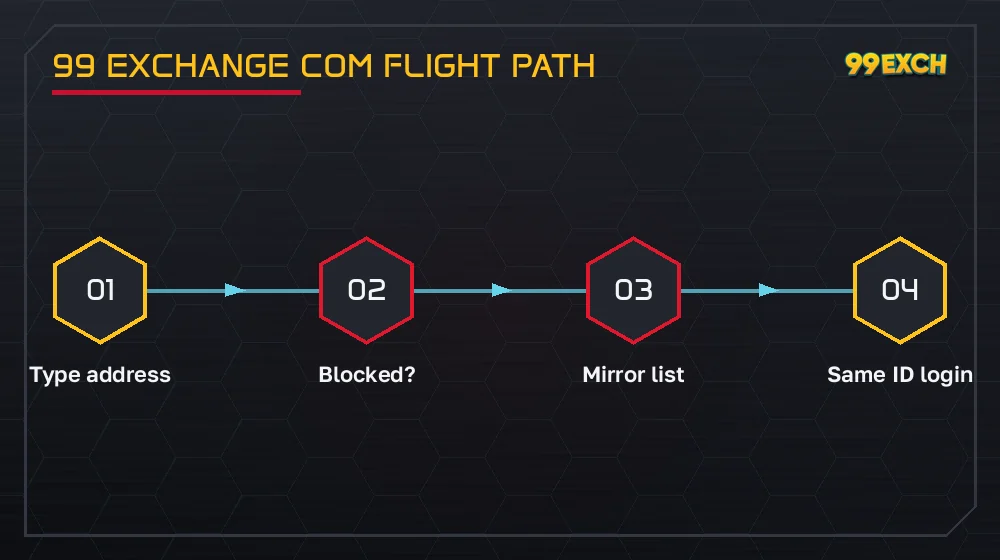
A block is a list kept by your internet company, and a domain name lands on it. Your phone asks for 99exch.com, the provider checks its list, and the request quietly dies there before it ever reaches 99Exch. Across town, a customer of a different company asks for the identical name and gets the sign-in. The account sat untouched the whole time. Wrong road, right destination.
A mirror is a second domain name aimed at that same 99Exch login. Think of it as another gate into the one airfield (the runway, the hangar and your locker are all the same; only the entrance sign differs). Because the blocking is done name by name and provider by provider, a .red or .green address can open fine on Jio while .com stalls on a broadband line in the same house, and the reverse happens too.
That is the theory. In practice, people mostly notice it on a busy match evening, retry the same address five times, and assume the 99 Exchange site is down.
Picture a common evening. A player opens 99exch.com from a home screen shortcut at the toss, the page spins for half a minute, and he reloads it again and again. His friend on another provider is already signed in. Nothing is wrong with either 99Exch account; one connection can reach the .com name and the other cannot. Switching the first phone to mobile data, or opening 99exch.live instead, would have put him on the same screen as his friend within a minute or so.
Fast sign of a provider block on 99Exch
99exch.com spins forever, or your broadband company's notice sits where the 99Exch form ought to be. Same phone, same minute, on mobile data: if the form appears there, the the name was blocked on one line only.
Fast sign the 99Exch address itself is wrong
A page loads, but it is a not-found message or a site that looks nothing like the sign-in. That is a typing problem or a lookalike domain, not a block.